Welcome to My Blog!
Updated Nov 2024
Welcome to my little corner where I share cool projects, fascinating discussions, and adventures from my studies and travels.
Browse through the categories to read topicsthat you might be interested in :)
New Cities
Winter 2022
In Winter 2022, I took the New Master-Planned Cities course with Dr. Sarah Moser at McGill University. This course examines the origins, designs, motivations and cultural politics of planned cities, focusing primarily on those currently under construction in Africa, the Middle East and Asia.
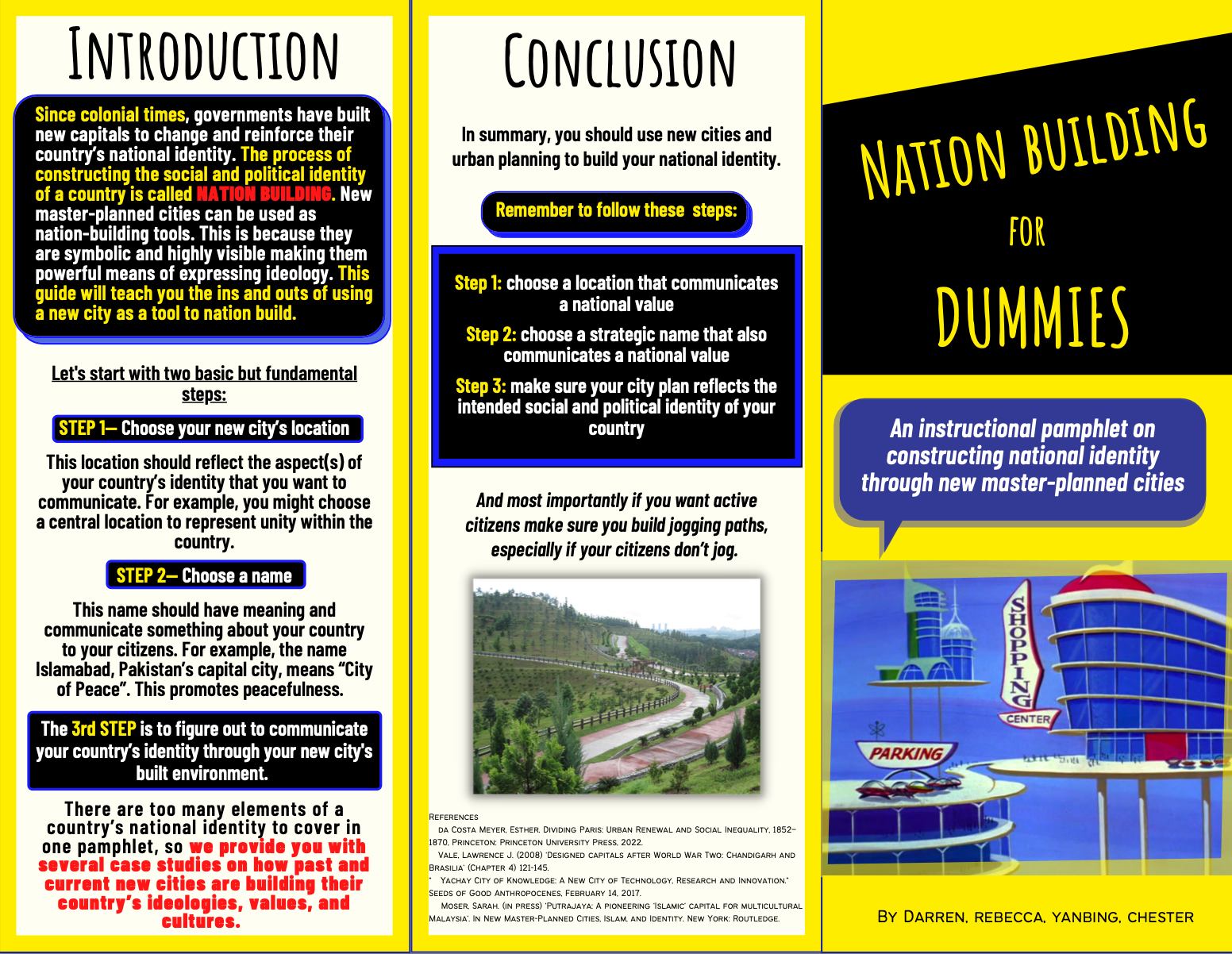
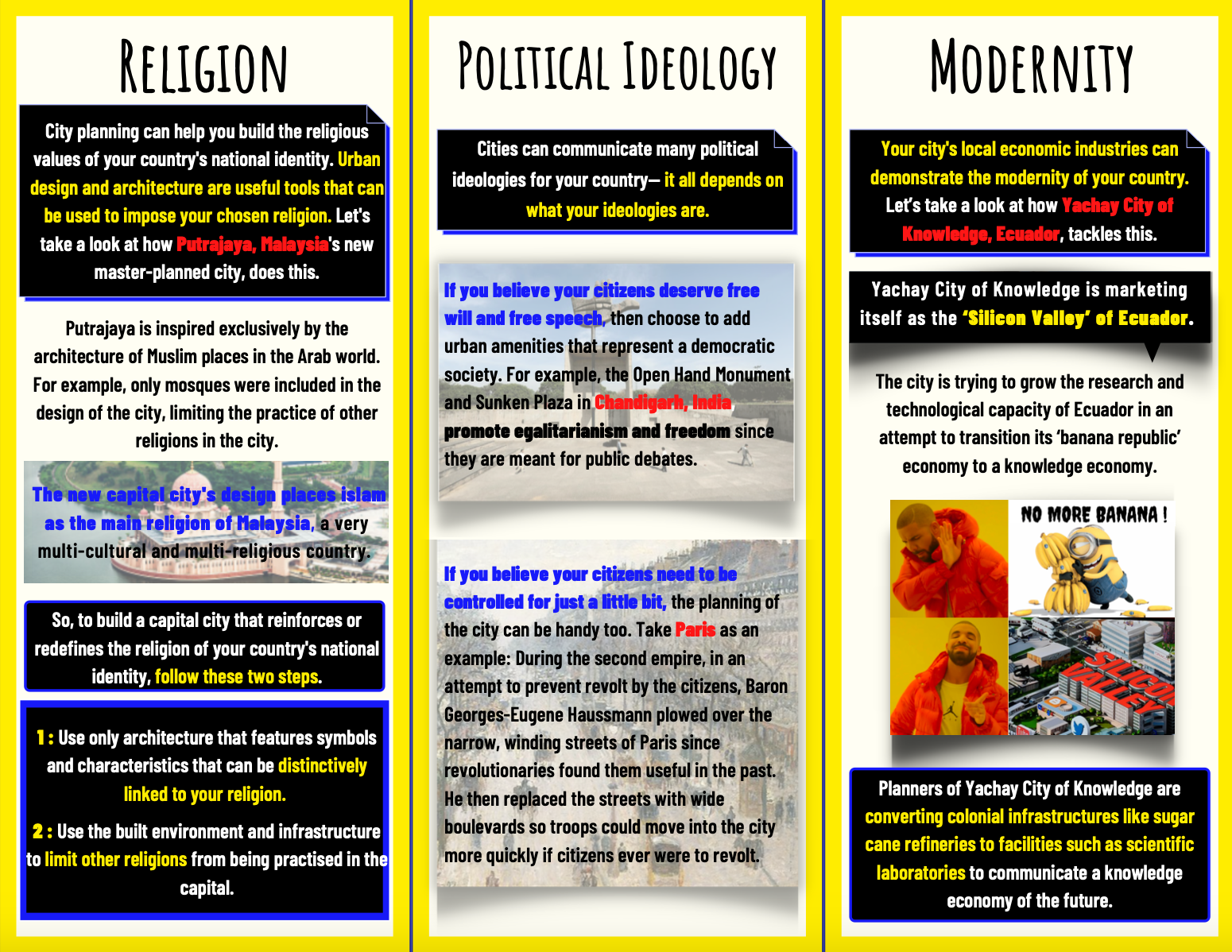
Nation Building for Dummies is our fun take on breaking down how nations use cities to reflect their identity. From culture and geography to architecture and politics, we looked at how these elements play a role in shaping a country’s image. By diving into examples like Malaysia’s Putrajaya, Ecuador’s Yachay City, and India’s Chandigarh, we explored how urban design can express everything from religious values to a push for modernity.
This project was a creative way to wrap up what we’ve learned in this fascinating course. We wanted to share these ideas in a way that’s both entertaining and easy to understand. It’s interesting to see how cities and spaces aren’t just places but tools that reflect and shape a nation’s story.
This is a collection of my discussions in Facebook group about various aspects of new cities. Topics covers from sustainability to cultural identity and economic development.
There are many insightful articles brought up by other classmates about the new capital city in Malaysia, and here is another one discussing the colonial legacy in Jakarta, the current capital, and its relation to the new capital project. I really like the 'alun-alun' example in the first part to demonstrate how colonialism reflects on the urban layout. Alun-alun is a large open lawn area that serves as a gathering and recreation spot in every city, even in a small town. However, Jakarta does not have an alun-alun. As the author points out, "This is because much of the city's footprint was laid out by foreigners to suit their tastes and needs. It was a city built to serve the commercial interests of a foreign power, and many, though not all, of its modern urban problems, partially stem from that." Hence, the new capital, Nusantara, will represent from the ground up an Indonesian vision of the country and its future, free from colonial legacies.
I'm considering the question, "Does Indonesia really need a new capital? Can their attempts to build new cities be accomplished by transforming existing ones?"
I started to ask myself these two questions when thinking of new city projects since last time talked with Wukai Jiang about Busan's Eco-Delta Smart Village. His thoughts really inspired me, that Occam's razor applies to new city projects as well, entities should not be multiplied beyond necessity. New cities are needed only if it is impossible to transform the existing cities, and what we need is smarter/ green/ decolonial/… cities, rather than more cities. When it comes to Nusantara, is it a necessary project for Indonesia to completing get out of its colonial footprint, a redundant project demonstrating the government's incompetence and bad performance with the existing capital city, or a corruption scheme disguised as 'building the new city' as Dompak?
Paris or China: Can you tell real thing from
replica?
We discussed a little bit about this phenomenon in class before and I
want to elaborate more from my understanding.
In China, we have a derogatory phrase "崇洋媚外", which refer to a kind of
mental state that worships western culture but despises our own culture
heritage. This is extensively used when we discuss culture, social life,
politics even economics… I think replicating foreign architecture is a
very typical example of worshiping western culture.
The origin of this mental state could be traced back to the late 19th
century and divided into 3 eras. First, China in the late Qing Dynasty
became semi-feudal and semi-colonial since the late 19th century and
lasted for a half-century. Chinese elites found that China lagged behind
the West in every aspect, military, politics, technology, culture,
education and so on. This provoked elites to advocate ''learning from
the West and transforming China''. The reform progressed from pure
technology to culture and gradually warped over time; for example, the
"abolition of Chinese characters" was once a popular proposal among most
outstanding intellectuals. This was the first time that the social
phenomenon of worshiping western culture while despising Chinese culture
heritage appeared in Chinese history. As a result of colonization, we
can see that the culture of entire conversion to the colonizer's culture
was first extensively spread among the elites.
The establishment of the People's Republic of China (1949) was the start
of the second period and the denial of this mental state. During this
time period, China eliminated and expelled imperialist armed forces,
confiscated imperialist assets in China, and entirely got rid of its
semi-colonial status, therefore eradicating the political and economic
foundations for this mentality. Additionally, China was blockaded by the
United States and the Soviet Union, private international relations were
effectively shut off. The worship of western culture temporarily faded
into oblivion.
The resurgence of this mentality began with the opening of China in
1978. Only the elites had access to western culture whereas civil
society remained secluded from it in the late 19th. But in the 1980s,
more and more Chinese civil could get into the Western culture from
media, books, television, individual experience, and stories from
others. the citizens have been actively engaged in international
exchange, such as tourism, education and sports. Hence, similar to the
late 18th century, the idea of learning western of all aspects and
self-depreciation prevailed again and was more intense than ever before
based on the huge gap of development in the late 20th century. The
generation currently in power was greatly inspired by the 1980s and was
naturally keen to emulate many aspects of Western culture, including
architecture. It's worth emphasizing that the vast majority of senior
Chinese officials were not permitted to leave China unless there were
exceptional circumstances, and when these two elements combined, they
inevitably chose numerous schemes emulating foreign design.
As the old saying goes, the grass is always greener on the other side of
the fence. I think both China and Western have outstanding cultural
heritage, but the social phenomenon of “worshiping western culture while
despising our own cultural heritage” has a profound effect on Chinese
society, as whatever is foreign is labelled as “outstanding, luxury,
premium”. Another example is that developers tend to name their new real
estate projects in English-translated Chinese to label them as luxury
neighbourhoods. My aunt once lived in a middle-class district in
peri-urban Shanghai where there are 10 neighbourhoods and all are named
in English, such as the translation of “Bruce County”.
With the rapid development of Chinese economics and the improvement of
Chinese average living standards, more and more people began to reflect
on this deformed social phenomenon. In fact, many citizens criticize and
scold the government's behaviour of blindly replicating foreign
architecture. We start to realize that appreciating our own precious
cultural heritage is as critical as absorbing excellent western culture.
In 2020, the Chinese Ministry of Housing and Construction expressly
informs large public buildings are strictly prohibited from copying or
imitating. This is in corresponds to the Chinese policy of rebuilding
cultural confidence.
Busan’s Eco Delta Smart Village
The article and the comments have made me consider the relationship
between culture and the various perspectives on the new city project.
After reading the article, my first reaction was the same as Jeong Mi
Sook's: "What a fantastic and futuristic experiment!" How come this is
happening rather than just being shown in a promotional video? I want to
be a part of it and live there." I also shared this article with some
Chinese friends, and they all showed a technology-optimistic attitude
towards this project. However, as I browsed the comments, I found that
most people criticize it in the context of the environment,
individuality, inorganic development, data privacy, etc. This inspires
me to think about the relationship between different cultures and their
reaction to new cities. How other groups are influenced by their
culture, which leads to them having different views of the new city from
different perspectives, is a fascinating topic that deserves more study.
Just as the first comment stated, “Different strokes for folks raised in
different societies.” From my perspective, the Asian community has a
tendency to worship high technology and the prosperity of
industrialization, prioritizing them when considering pertinent issues.
In comparison, western society emphasizes more on justice and equality,
such as environmental justice, social justice, marginalized community,
racial equality, and privacy. This results in enormous distinctions when
individuals from diverse cultural backgrounds consider the same project
and may even determine one project's outcome. Nothing is perfect; the
new city is not a panacea or magic bullet that could perfectly solve
every issue or satisfy everyone. Thus, when we make comments about the
new city project, I believe it is critical to understand which aspects
we prioritize and why others hold divergent views and think in
particular ways.
Our Urban Future May Be a City in a Box
Check out this 15-minute video, I really like the beginning of this
clip, the satellite motions illustrate how quickly the new cities are
being built and how fascinating they are. (Isn’t the narrator’s voice
familiar
Previous discussions about Songdo primarily focus on the privacy issue
and district design, this video brings up very detailed design stories
behind the scenes and illustrates another intriguing concept: “The city
in a box”.
The majority partner of Songdo is Gale International, a privately owned
real estate development based in New York. Gale draws on the precedent
culled from other successful places, such as Boulevards of Paris, Grand
Canal of Venice, Central Park of New York City, Row house of Boston Bay.
Packing all the successful designs, they wish to create a replicable
model city and duplicate the Songdo Model to the rest of the world. The
current new project they are working on is Meixi Lake in Changsha,
China. "We visited Changsha several times." The representative of Gale
International stated that the company planned to select a similar site
in China. They plan to build Meixi Lake into an international integrated
functional area, including international exhibition center, office area,
innovation center and inhabitant area.
This concept reminds me of what we learnt about the Korean LH
corporation. It exports ‘the Korean new town model’ to the world,
especially in Africa. This model is very standardized as well,
constructing a new city and context-appropriate industry in 5 years.
What do you think of these standardized models?
An Update on China's Largest Ghost City
I am quite interested in Ghost cities in China, so after class I look
through some intriguing articles and here is the one. Unlike most of the
Op-Eds criticizing low occupancy and real estate bubble in Kangbashi,
the author thinks Ghost city is a misreading of Kangbashi. “The presence
of unoccupied homes is less of a calamity and more the result of complex
social, political, and economic forces that’s more or less a normal part
of China’s particular method of new city building and vitalization. And
the emptiness of Kangbashi itself is a deception. In point, you can’t
just show up in a developing Chinese city, take some pictures of empty
buildings, and jump to the conclusion that they are harbingers of an
impending economic doomsday.”
Beyond that, he further points out the design creates a car city, and
the quality of urban life may be jeopardized by a lack of consideration
of street life. The spacious boulevard and few walking area led to few
places for inhabitants to hang out, which make Kangbashi still looks
like a ghost city, with 100,000 people here.
A lot of urban design has been criticized for having too many lanes and
neglecting street life, such as Songdo and Kangbashi. Many articles
argue that the expanding road network won’t solve traffic congestion,
only leading to more drivers and more cars on the street. However, this
is a trending, even standardized street design in Chinese new city.
Large population and traffic congestion may both be factors that taken
into account. What do you think of this kind of street design?
Dompak: Tale of Corruption
I looked up some articles and videos about Dompak after the guest
lecture, and here is the one written by Sarah, discussing unprecedented
corruption. At the deadline for completion, only a third of the city
infrastructure had been completed, while 75% budget had been spent. The
loss of the initial investment monies, the stalled construction, and the
missing fines all point to an Indonesian political climate rife with
corruption.
I brought up the corruption issue in Dompak to reflect on the new
planned capital city, Nusantara in Indonesia. I saw many classmates post
very insightful articles on this new city project, focusing on ecology,
the relocation of the capital, and the lessons to be learned from new
capital projects in other countries. From my perspective, corruption
would still be an important issue to deal with in the new capital
project. As Sarah mentioned, “In a climate of rampant corruption,
government officials do not appear to fear any consequences of their
actions… new cities such as Dompak are proving to be an unprecedented
opportunity for corrupt officials to personally enrich themselves.” Over
one decade, the Corruption Perceptions Index of Indonesia has not
changed a lot, rising from 32 to 38.
I am not very familiar with the government structure of Indonesia, so I
wonder whether the level of the project would have an impact on
corruption. In other words, Dompak is designated provincial capital
while Nusantara will be a national capital. Corruption is certain to
exist in Nusantara, but will government officials be less corrupt out of
fear of failing to execute the city's most significant new city project?
I would love to hear your opinion on this.
Xiong'an New Area: 5 Years On
While the delineation of the Xiong'an New Area is significant for the
party, the period is not optimal for Xiong'an. CCP has extremely high
expectations for Xiong’an, but I do not feel that new technologies and
models proposed by numerous institutions will determine Xiong'an future
development.
I think that what will truly facilitate the development of Xiong’an is
the fact that the central government has granted Xiong'an the right to
explore through institutional mechanisms and a more expansive
exploration space than ever before. However, even with fault tolerance
and exploration, there will be policy instability for a long period of
time.
Construction of a new area in China tends to be extremely rapid. Once
the government has decided to designate a piece of land, it frequently
completes dozens of square kilometers of construction within two years.
Xiong'an is unlike any other new district built in China in the
preceding decades in this regard. The government attempts to investigate
the land use system, the property rights system, the relationship
between government and business, the relationship between government and
enterprises, and the reorganization and reconstruction of the complex
relationship between short-term economic benefits and long-term public
services, as well as long-term population quality improvement, at each
stage of the construction and development process.
'New Town', Same Old Mistakes
Thank you for posting this article! The lack of accountability isn’t a
new topic when discussing new city projects. The gross delay of the
Purbachal project reminds me of Dompak. 75% budget had been spent,
whereas only a third of the city infrastructure had been completed at
the deadline for completion of Dompak. When new cities became an
unprecedented opportunity for corrupt officials to personally enrich
themselves, it is not surprising to face the loss of the initial
investment monies, the stalled construction, and the missing fines.
This inspires me to think about the ‘PowerPoint City’ Sarah mentioned in
the recap lecture. Several possible reasons include: Government tends to
make unrealistic magnificent plans, so it’s nearly impossible to
complete; Unexpected excess funding shortage further leads to
incompletion while in the process; The government transparency index is
very low, which tightly related to lack of accountability and
corruption. I browse google scholar and haven’t found anything relevant
article systematically examining the main reasons behind the unfinished
city projects. Probably a good term paper topic for upcoming students
Utrecht's Exemplar City Design That Prioritises
People Over Cars
This article discusses a new neighborhood called “Merwede”, which is
located in Utrecht, Dutch. In 2020, Utrecht unveil its latest masterplan
for a completely car-free city.
Compared to other cities that claim to be car-free (e.g., Jeddah and the
Line), this project seems more attainable and reasonable to me. There is
a deep tradition in Dutch of biking instead of driving. The total
population of the Netherlands is 1.7 million with overall 2.2 million
bicycles and the bicycle pathway spans more than 35,000 km across the
entire country. Hence, Dutch is known for the kingdom of cyclists. This
illustrious reputation is best reflected in Utrecht, which is home to
the world’s largest bike parking lot.
In GEOG217, we learnt that urban imagination has two distinct aspects:
Reimage urban life and powers to reshape cities. The former emphasizes
relationship between cities and inhabitants, while the latter addresses
the ideology, social status of the city planners. Regarding the
relationship between city and its inhabitants, I believe that the
residents are the owners of the city and should be the primary factor
when planners make the masterplans. However, many city plans have
reversed the relationship between the two, trying to display the
developing progress of the country through grand narratives while
ignoring inhabitants’ custom and tradition. This, I believe, is what
Merwede shines at. The city is not visual spectacles with towering
skyscrapers or giant, representative buildings. It is the place where
inhabitants live. Merwede does an excellent job of respecting local
culture while integrating the new concept city planning based on their
custom.
King Mohammed VI Green City
In September 2010, Morocco King Mohammed VI unveiled a new city project
“King Mohammed VI Green City” (VVM6). This new city is adjacent to
Benguerir, an existing city of 80,000 working class with high
unemployment. According to the master plan, VVM6 is a new city whose
identity revolves around knowledge, research, and sustainable
development; an ambitious urban project built with the Mohamed 6
Polytechnic University at its core and as a driving power for its
development.
VVM6 is a spatial expansion of the Benguerir. This prompts me to think
about the tight relationship between the existing city and its adjacent
new city. It seems like planners want to address the current economic
problem in Benguerir by constructing an adjacent new city. However, the
main economic industries are so distinguished from each other that I
wonder how these two cities will make full leverage of spatial proximity
to boost economic development. VVM6’s economy will be centred on
universities and R & D, which will attract educated elites; while
Benguerir is known for the phosphate rock industry, which is crowded
with working class. Apart from that, how will VVM6 embrace Benguerir's
current inhabitants?
The previous student Chloe McGuire also shared an article about this
city. They discussed the changes in the city model in the post-pandemic
period, and how might VVM6 planners modify their plan in response to the
publicization of private space. You can also take a look at this article
if you find it’s an interesting topic. The Big Picture: Green City, Benguerir
There are not many videos or articles about this city, even though the
project was announced 10 years ago. Please feel free to attach the
latest updates if you found some!
China's Largest Ghost City Booms Again Thanks to
Education Fever
The author tries to explore the main driving force behind the renewed
Kangbashi, arguing that school district effects on housing prices
predominate. However, I want to point out that there are some arguments
that is not that accurate in my point of view.
The article states “Tight regulations surrounding school districts
require parents who want to send children to a particularly coveted
school to own a home within the district.” This concept is correct when
we talk about Chinese elementary school, but not high school or middle
school.
Chinese students have a provincial-level high school entrance
examination at the end of their grade- 9, the results of this one-time
examination determine which high school you can enter. Similarly, the
ranking and scores of the national university entrance examination are
the only factors that determine which university one can enter. Top
public high schools(not private schools) like Ordos NO.1 high school
select students only based on scores, just like McGill. Even if one
parents own a home near Ordos No.1 high school, one cannot have the
chance to enter without excellent scores in that exam. In terms of
middle school, tier 1 middle schools will organize their own exams for
grade-6 students and give offers to satisfied students, students can
choose the school if they pass two or more. Take me as an example, I
took 2 different entrance exams at 12, I failed the best one (270 out of
8000 students) and passed the second. If I didn’t take these exams, I
could go to a middle school near my home, but it has much lower
educational quality. Overall, scores determine whether one could enter
top middle school, high school, and universities, rather than purchasing
a new house near a relevant school.
In addition, Ordos NO.1 high school provides 5 residential apartments
which could contain 4000 students in total. Residential apartments are
quite general among top high schools in China since many top students
may come from other cities in the same province. I found the planned
enrollment number of the school is 1152 in 2020, which is announced by
the Ordos government. This implies that there are enough dormitories to
accommodate all the students. Fun fact, public high school residential
fee is super cheap in China, ranging from 500 -1000 CNY ( 100-200 CAD)
per term.
My opinion is that parents purchase new apartments near school simply
because they want to live with their children, talk to them and support
them in this special period (since we are not allowed to use phones in
high school, which means parents can only talk to their child on 1-2
days a week). Everyone is under high pressure in High school. We had a
midterm, final, monthly even weekly test on 6 disciplines, the
university entrance exam scores determine our university, no regular
grades, no extracurricular, only one-time ranking among 400,000 grade-12
students in the same province. (You have to get the first 50 out of 400k
if you want to enter Peking or Tsinghua University). Think about how
stressed students are. Naturally, parents want to take good care of
their children, comforting them when they are frustrated, encouraging
them when they make progress, making sure their children are physically
and mentally healthy, talking to them from time to time. As a person who
experienced this period, I know how much my parents were worried about
me and how much they care about my mind. I think this is one reason that
cannot be ignored.
The president of El Salvador, Nayib Bukele, has announced the intention
to create the first Bitcoin City in the world in the east of the Central
American country, in Conchagua. The creation was announced in a massive
event in November 2021, the construction is to start in 2022.
The ambitious circular development, designed by Fernando Romero
Enterprise - Free, includes areas for cryptocurrency-related technology
companies, residential areas, an airport, and a seaport. This smart city
will generate its own power from a nearby volcano. El Salvador, which
legalized bitcoin this year, began mining bitcoin last October through
volcanic activity. To achieve efficiency and sustainability, the city
features a large central square with a museum dedicated to the history
of money, intelligent buildings equipped with cutting-edge technology,
and a large multipurpose stadium that can accommodate a variety of
events.
This is not the world first cryptocurrency city in the world. Back in
2018 and 2020, Rapper Akon successively claims 2 new cities in Africa
would create by him, One in Senegal and one in Uganda. Cities will
function entirely through Akon’s own cryptocurrency, Akoin. However, I
cannot find any on-the-ground construction updates about this
cryptocurrency city. The 1st phase of Akon City initially was expected
to be complete by December 2023, due to the amount of infrastructure
required, the city would not be complete until 2036. Hence I am very
skeptical about the bitcoin city in EI Salvador, just like the plan
announced by Rapper, it seems like a futuristic wish rather than an
executable plan.
Xiongan: A New City for the Future
China announced the establishment of the Xiongan New Area on April 1,
2017, aiming to relieve Beijing of functions non-essential to its role
as the national capital and to advance the coordinated development of
the Beijing-Tianjin-Hebei region. This is a continuous trending topic in
China since the announcement. Xiongan is designed to become a livable,
green and business-friendly area and also a digital zone for innovation.
It is built up in a smart city framework with an urban computing center,
block data platform, the Internet of Things integrated open platform,
video network platform and construction information modelling (CIM)
platform.
The article offers a brand new perspective of interpreting Xiong'an that
I had never thought of: "Building a model city has a long tradition
among China’s reform-era leaders." Shenzhen is forever connected with
the name Deng Xiaoping(China approved to establish Shenzhen special
economic zone in 1980); Jiang Zemin's legacy is inextricably linked to
Shanghai Pudong District(from 1990); The fourth president Hu did not
mark any city; Now, Xi is attempting to link his name to Xiongan.
Shenzhen and Shanghai indeed are economic miracles and blueprints in
Chinese history. I am looking forward to seeing how Xiong'an will be
written in Chinese history in the future —— another megacity in Chinese
inland or a huge failure?
China Has Officially Started Construction on the
World's First "Forest City"
I look up the Liuzhou government website as well as the Guangxi
government website, but I do not find any announcement about the plan or
launch of this “vertical forest" project. I found out that a reporter
from the South China Morning Post contacted the Liuzhou City Planning
Bureau by phone in 2017, and the Liuzhou planning department said they
have never published the relevant information. It looks like even though
the Liuzhou government might intend to call for drafts on the new city
planning, the vertical forest plan is not adopted.
The idea of forest city construction is to mitigate climate change,
relieve the excessive steel and concrete exterior of the city, and add
green space to the city. But in fact, Liuzhou is a livable,
environment-friendly medium-sized city in China. Surrounded by mountains
on three sides and flat terrain, with the Liuzhou River running through
it, Liuzhou has 65% forest coverage and extremely high air quality.
The concept of "forest city" is not a panacea that can be applied to any
city, especially to an area where the natural ecological environment
itself is an advantage. In addition, Liuzhou is not a strong economic
city, the price local citizens can afford cannot support these forest
buildings. From my perspective, “vertical forest” is likely to become
another ghost city if this plan once launch.
NEOM Tech Digital Co. Unveils
The quote "The future will be defined not by megacities, but by
cognitive meta cities” in the article piques my interest in “mega
cities”. I browse the relevant materials and find 2 typical statements:
The first statement is that the term meta city is used to describe the
linking of megacities via high-speed transport and critical
infrastructure. This statement implies that meta cities consist of
several megacities and have a larger scale. If so, it seems contrary to
the quote “It is a vision focused on experiences rather than scale”.
The second statement emphasizes the virtual meta-infrastructure in the
city that constitutes urban configurations, new digital sensing,
communication, and social networking technologies. I also look up the
term “cognitive city”, which expands the concept of the smart city with
the aspect of cognition or refers to a virtual environment where
goal-driven communities gather to share knowledge. I think this concept
is quite similar to statement 2 of megacity (Perhaps because I do not
know much about cutting-edge technology so I do not know much about this
technical jargon). From my perspective, the CEO seems to be just talking
about building smart cities with some seemingly profound technological
jargon.
How to Build a New City from Scratch
The article sharply points out the shortcomings of many new cities in a
humorous and witty tone, as well as pointing out many meaningful
explorations of new cities. I came up with an idea about the smart city
“the Line” in Saudi Arabia when I read the second part addressing the
water problem.
One of the most striking aspects of THE LINE's design is the single
central rail line up to 170km across the country, which is also very
confusing. Given that the center priority when considering building THE
LINE is to resolve the water shortage, perhaps this is where THE LINE, a
straight line, originated. The construction of a desalination plant on
the Red Sea to supply the city with constant water is a prerequisite for
the construction of NEOM. And the pipe that supplies the city should be
a straight line. The most efficient method of supplying the city with
water via this pipe is for the city to grow in a straight line parallel
to the pipe's direction. Thus, the infrastructure of water transmission
may be one of the logic behind this straight line city, and the shape of
the straight line may symbolize the city's "living by water" to some
extent. I really love this article!! And the steps mentioned have
prompted me further thought about many new cities.
Russia's New Arctic Project Will Be Biggest in
Global Oil
Anna notes, unlike the vast majority of cities, these new cities are
focused on industrial development rather than urbanization, which means
that the wealth of resources available at the site will support
employment and economic development in the new cities for quite some
time compared to other new cities.
It is worth noting that these new cities are in Siberia, not in the
triangle that culminates in the cities of St. Petersburg, Novorossiysk
and Irkutsk, where most of the Russian population is concentrated. The
trend of population movement shows that this triangle is continuously
absorbing the Russian population due to climatic and historical reasons,
and the distribution of the Russian population is becoming more and more
uneven.
Siberia occupies about 3/4 of Russia's territory but is home to less
than a quarter of the population, so I think the priority of building
these new cities is to consider how to attract people to move here and
settle down. Energy development is a huge advantage in establishing new
cities, but the cold and uninhabitable climate is also an important
issue to consider. Climate change makes artic silk roads possible, but
it does not mean that these new cities will immediately become places
suitable for living.
Five New Cities in Shanghai
These five new cities (in China we called districts since they are still
in Shanghai municipal district) have been planned and built far before
2021. In 2001, Shanghai Government first brought out the idea of “One
city and nine towns” during the “Tenth Five-year Plan”, in an effort to
construct a system of a mega international economic center. Songjiang is
one of the towns. At the beginning of the construction in 2011, the
planning projected a population of 600,000 by 2020. In the newly revised
plan, the resident population of the new city is expected to reach 1.1
million by 2020. However, by the end of 2010, the population of
Songjiang had reached about 1.28 million. And Songjiang has a population
of 1.91 million by the end of 2021.
The syphoning effect of a large city like Shanghai has resulted in a
rapid increase in the population density in and around Shanghai. As a
result, traffic congestion and housing shortages worsen. Hence,
‘accelerating the construction of five cities’ mentioned in the article
is a modification based on the finished initial plan, which tries to
mitigate these problems.
I interviewed one of my friends who has been living in Songjiang since
his childhood. He says that Songjiang was really small when he was
young, with only 3 horizontal streets and 3 vertical streets. But
everything changed since 2014, with well-established infrastructure,
more and more people crowd in. To alleviate rising population and
traffic congestion, Songjiang is building Shanghai's first networked
tram system, with 75 kilometres completed by 2020. He is astounded by
the rapid pace of development and proud of the Shanghai government's
foresight.
In my perspective, Shanghai's urban planning framework serves as a
blueprint for other Chinese cities. Instead of focusing exclusively on
the next few years, urban planners should consider the trajectory of
urban development for the next 20 or 30 years and plan ahead to avoid
urban problems.
Land Grab or River Revival inside 7 Billion Ravi
City Project
I think this article addresses some critical issues when new cities are
built on top of existing cities where thousands of people currently live
rather than on empty land: What will become of the low-income residents
who have lived in this area for a long time? How will the government
resettle these residents? Does the government treat them properly? Will
they continue to be marginalized under the reconstruction of the city?
Although the main from RUDA point out that there won’t be any forced
acquisition, there must exist some gaps between the overall guidance of
the program and concrete implementation. For example, The government
designated portions of the Warraich family's land as barren, despite the
fact that they are viable for farming, and offered him less than the
land is worth.
This reminds me of the large number of demolition and relocation
programs that have occurred in the downtown segments of some Chinese
large cities, and we call it “urban village”. Urban villages are a
distinct phenomenon that developed as a result of China's urbanization
initiatives. They are frequently inhabited by the poor and itinerant,
and as such are associated with squalor, overpopulation, and social
problems, thus why governments want to start the relocation program.
Depending on the financial expenses of different cities, urban villagers
may have different levels of compensation. Some could become rich
overnight after their family home are dismantled to give way to new
housing estates because the developers had to compensate them with a
huge sum of money. However, some individuals will confront an unjust
compensation arrangement that forces them to live a worse life.
Montreal Urban Studies
Summer 2022
I took the Urban Field Studies course with Dr. Sarah Moser at
McGill University in Summer 2022.
This course has opened a window for me to forge a deeper connection with Montreal. By “deeper,”
I mean that Montreal has become so much more than just the city where I completed my
undergraduate studies. Through a geographical lens, I’ve learned to rediscover, study, and
reflect on this incredible city, and in doing so, I’ve grown to love it even more.
Now, whenever I talk about Montreal, I don’t just share its tourist attractions—I share its
living, breathing, and hidden stories tucked away in its streets and neighborhoods. Below, I’ve
gathered some of the most fascinating moments from my field studies, moments that reveal the
spirit of this vibrant city.
The Milton-Parc neighbourhood, known by students as the ‘McGill ghetto,’ spans six
square blocks, is one of Montreal's oldest neighborhoods, with homes built between
1875 and 1900 for the bourgeoisie.
In the 1970s, the whole neighbourhood was targeted for regeneration which would
gentrify it and make it unaffordable for original residents. In response, the
community mobilised to find a long-term solution and avoid evictions, resulting in
the creation of the Communauté Milton Parc (Milton Park Community – CMP). Up to now,
there are 22 nonprofit housing co-ops and 1500 people in residence, and all land is
owned in common.
As a student who lived in Milton-Parc, specifically on one of the high-rise built
for regeneration on phase 1, I with other 3 of my teammates create a documentary
about it - for this familiar but not-that-familiar place.
As part of the course, we were asked to conduct ethnographic research, so after exploring the gay village in more depth, I decided to focus on drag shows. This was a completely new experience for me—I hadn’t even known about drag shows before. With curiosity and excitement, I went to a bar with a queer friend that hosts drag performances and documented the experience.
While gentrification and the canal’s decline have softened its former glory, Little Burgundy remains one of my favorite hidden gems for a city walk. Its streets still echo with the stories of its past. Here are some of pics that documenting how time brings changes to Little Burgundy.
Regeneration in Shanghai Expo Area
Apr 2021
The Global Places and Peoples was the first Human Geography course I took. One of the assignments was to document urban regeneration. Since the course was fully online during COVID, and I was interning in Shanghai at the time, I chose to document the urban regeneration happening near where I lived — the Shanghai Expo Area.
Oral History: The Summertime in Wuhan
Feb 2021
Hubei Province's capital, Wuhan, is the economic and geographical heart of China. The "Golden
Waterway" of the Yangtze River and the Han River traverse the urban area and divide Wuhan into
the three districts of Wuchang, Hankou, and Hanyang. As the hub of north-south transportation,
Wuhan is an important Yangtze River port city in the middle reaches. From the late Qing Dynasty
through the Republic of China (1850s–1930s), it was China's second most cosmopolitan city after
Shanghai, and the United States referred to it as "the Chicago of China." Wuhan is known as the
"Land of a Thousand Lakes," yet its abnormally hot summers have earned it the nickname
"furnace." Humidity and heat are blended in the city, making the residents' summertime
recollections quite vivid and clear. On a weekend in May 2022, I conducted an interview with my
grandfather, Sun Cheng 'ai, who was born in Wuhan in 1947, studied and worked there, and is now
a senior citizen in the Hankou district.
The family link allowed the interviewee to respond without reluctance or reservation to any of
my inquiries. In addition, my 18 years in the city have provided me with a profound awareness of
my homeland and enabled me to pose more pertinent questions. In addition, my status as an
environmentalist may have an impact on my queries.
Both of Sun's parents worked for Yangzi Shipping Corporation on the dock. They lived in the
Pinehurst area, which was close to the pier and populated by working-class dock employees and
their families. The majority of the buildings are constructed in the distinctive Chinese style
of Longtang, which consists of rows of ancient, dilapidated triplexes. These dwellings are of
concrete construction, with low cost, compact layout, and small alleyways. "The Pinehurst area
was not vast, only a few dozen metres from the entrance to the back of the alley but filled with
two-thirds of my life." He recalled.
Childhood Night
From the 1950s to 1970s, since few cars were on the roads and buses only ran on the main street,
the bamboo beds became synonymous with Wuhan summers. Every summer, all households carried their
bamboo beds to the side of the road to enjoy the cool. Due to the tight streets, parents would
be the first to try to grab the finest site after work, forcing latecomers to place their beds
in the middle of the road. Summers in Wuhan were quite hot, and after a day of sunbathing, the
slippers would become sticky and soiled on the asphalt. After securing a proper sleeping site,
residences used a basin or bucket full of water to uniformly sprinkle the bamboo bed and the
ground. The water will evaporate quickly, therefore one had to sprinkle multiple times in
succession to cool it down. Families brought their meals, iced watermelons, sodas, and beer to
the bamboo bed. Since there was no refrigerator at the time, the watermelons, sodas, and beer
were essentially soaked in tap water to cool them. Men would quarrel over a topic after three
rounds of drinking, shouting; ladies would also discuss a resonant point, laughing; and children
were racing around the bamboo bed.
At seven or eight o'clock, when the sun had completely set, the neighbors had already packed up
their food and were sitting on bamboo beds, eating watermelon and sipping herbal tea. At that
time, there were no skyscrapers in Wuhan, summer nights were not as hot as they are now, and it
was nicer to be outdoors in the middle of the night. As the conversation dwindled, the women
beckoned the children to sleep by stroking them softly with one hand while shaking a fan with
the other. At that time, there was no traffic in Wuhan, no major demolition, and the occasional
cry of a few children who did not want to sleep under the calm night was so comforting that the
neighbors went to sleep with the cool breeze and the soft harmonies of the robins. When the
first rays of sunshine touched the street, the neighbors in the worst positions would be the
first to feel the intense heat of the sun on their bodies. Everyone began to take their bamboo
mattresses and other belongings home like migrating animals, and then they showered and went to
work.
Being from Wuhan, Growing Up by the River
Swimming in the river was formative education for Wuhan children. In the 1950s and 1960s,
although the government prohibited children from swimming in the river due to the high incidence
of drownings, he would sneak to the river to play with his classmates after school. "At that
time, parents were unconcerned, sometimes there were patrol police at the river. As soon as we
spotted the police, we hurried to hide in the river to close the air. We showed up after police
could not see us. Therefore, every child's capacity to hold their breath was exceptional." he
joked. The restriction was abolished in 1970. Even as an adult, Riverside remained his favorite
place to unwind. Sun loved taking his children and riding his bicycle to river after work like
many other parents, with a large black tire on his head as a swimming ring. In those days, every
Wuhan between the ages of two and three had contact with the Yangtze River and used tires as
swim rings.
Swimming as a way for the people in Wuhan to escape the summer heat evolved into crossing the
Yangtze River. Chairman Mao enjoys swimming in the Yangtze River and East Lake, Wuhan residents
enjoy crossing the Yangtze River, and in those days, crossing the river signified a man's
maturity. The initial Wuhan River Crossing Festival was held in 1934, and the annual
International River Crossing Festival was a summer celebration in Wuhan, with all streets,
corporations and institutions, and civic organizations sending teams to participate and local
television broadcasting live coverage. When Sun was in his twenties, he represented his
corporation in the Competition for five years in a row, with the highest ranking of fifth place.
In addition to crossing the Yangtze River, Wuhan's urban culture also includes winter swimming
and jumping into East Lake. Sun stated that jumping into East Lake began as a protest against
the lake reclamation by developers, and soon after its ascent, like the Woodstock festival in
the United States, it transitioned from idealistic singing to an annual celebration for young
people. “It is our responsibility to live in peace with environment, as Wuhanese was born and
reared by the Yangtze River, the ‘Mother River’ that nourishes our children and grandkids.”
Urbanization, Degraded Relationship
From the 1940s to the end of the 1970s, Wuhan's economy was still dominated by Yangtze
River-centered water transportation. The building of the Wuhan Yangtze River Bridge in 1957
hastened the growth of land transportation, yet as an interior city, Wuhan did not develop
particularly quickly. The city core is near to the Yangtze River and close to Sun's home of
Pinehurst area.
Since the reform and opening up in 1978, Wuhan has accelerated its urbanization in response to
the state's urge. In his thirties, Sun was forced to relocate to the Evergreen Neighborhood, a
rural area at the time. This had little effect on his work, as the Evergreen Neighborhood was
closer to the paper factory where he worked. However, he was forever separated from his
neighbors. They were unable to sustain a durable relationship because there were no cellphones
at the time, and the camaraderie of sleeping and playing in the alley as youngsters gradually
faded away. "I miss Pinehurst area very much." he said, “Moving from a congested alley to broad
allotments, while the vistas are more expansive, the neighbors are not as close as they once
were – I have lived in Evergreen Gardens for thirty years, yet I still do not know many of my
neighbors on this block.” In addition, the relocation had also a significant impact on his
leisure. Sun used to enjoy relaxing by the river, but Evergreen Neighborhood is an hour away by
bus, so he can only go to the riverside once or twice a month and jogging in the park near his
home. Today, accustomed to strolling in the park and conversing with senior citizens, he no
longer visits the Yangzi River.
In addition to people's growing estrangement from one another, Sun thinks that their
relationship with the environment is also rapidly degrading. The demand for vast real estate
development has compelled developers to fill the lakes with land, resulting in increased summer
floods in Wuhan. The riverbanks, which previously established as a “Green corridor,” have been
meticulously renovated, and swimming is no longer permitted anymore. Swimming has switched from
the Yangtze River to indoor swimming pools, and many children have never played in the river.
The “Land of a Thousand Lakes” becomes a name in vain, and today's kids in Wuhan have lost
interest in the water. “Urbanization is a double-edged sword that has increased Wuhan's economic
prosperity but weakened the relationships between individuals and between individuals and
nature. I miss the day when I could freely swim in the Yangtze River the most.”
Dalian in 30 Years
Mar, 2022
Dalian is a coastal city in the northeast of China, and it is the capital of Liaoning Province. It is a beautiful city with a long coastline and a mild climate. I made this video with my teammates during GEOG 210, examing the changes of Dalian in 30 years.
Chinese Immigrants in Barbados
Apr, 2023
In March 2023, I took the Barbados Field Course with Dr. Thomas Meredith
at McGill University.
During my 10 days in Barbados, we spent two days exploring the island’s ecosystems, three days
engaging in discussions with officials from the Ministry of Health and the Environmental
Protection Agency to learn about Barbados’ efforts in addressing environmental issues,
especially in the context of global warming, and the remaining three days working on our group
project.
The inspiration for our group project came from a completely chance encounter. On the fourth
evening, I stumbled upon a Chinese restaurant near our base and met its warm and outgoing owner
from Northeast China. The owner mentioned that there is a significant Chinese immigrant
community in Barbados, with over 20 Chinese restaurants and around 300-400 Chinese residents on
the island. This sparked my curiosity—why did they come to Barbados? How did they get here? What
is life like for them? However, I found almost no information online, except for a
Beijing-Bridgetown project, and no relevant data or statistics. At that moment, I had a budding
idea: maybe our group project could focus on Chinese immigrants in Barbados. Although no one had
studied this before, the sample size seemed manageable, and it might not be too difficult.
And then—my idea became a reality! I will always remember the afternoon when my teammates and I
walked 30,000 steps along Highway H7 to visit Chinese restaurants, the morning we witnessed a
sheep being slaughtered on a farm, the fascinating interviews we conducted, and the sunsets and
late-night conversations we shared every day.
I am deeply, deeply grateful to my two teammates and all the restaurant owners we interviewed
for making it possible to complete the project I was most passionate about. It was an
unforgettable and unique experience. This is what I wrote to conclude my fasinating journey to
Barbados:
"As small as a country is, as long as there are human beings, there are wonderful stories,
contradictions and conflicts, efforts and struggles. Each piece of land has its own unique and
great story."
When I got off the plane in Barbados, my impression of Barbados was largely based on
its relatively isolated location and beautiful pictures online —— located on the
easternmost edge of the Lesser Antilles, it is a small, isolated island, with an
endless stretch of white sandy beaches, touristic hotels, brilliant sunshine, warm
climate, clear water, green and lush palms, as in most other Caribbean countries.
Since I visited Cuba two months before, I unconsciously compared Cuba to Barbados. I
expected that they would both be highly dependent on tourism, but I thought that
Barbados would have a more developed economy, low-lying, flatter terrain, less land,
and a largely Black population, who would speak English with a strong local accent.
As soon as I got in the van at the airport and hit the roads of Barbados and saw the
cars driving on the left side of the road, I could tell that it was a former English
colony. As the island is small, land is relatively scarce, and roads and sidewalks
(when there are sidewalks) are very narrow, forcing cars to closely pass each other,
making its public transportation areas seem less safe. And this was my very first
impression of Barbados: a typical Caribbean country, but relatively smaller and
isolated.
It is indeed small. Even among all the Caribbean countries, Barbados only ranks 14th
in size, and it takes less than two days for travelers to see all the major sights
from south to north. However, the intersection of the ecological vulnerability of
the island and the resiliency of its people, constitutes one of the most fascinating
landscapes in the Caribbean.
Situated on the boundary of the Caribbean and South American tectonic plates,
Barbados is still being pushed upward and slowly expanding by the converging process
of two plates. However, Barbados is vulnerable to the effects of climate change,
whether it is sea level rise, increased intensity and frequency of storms, or
coastal erosion; its land area is actually decreasing over time. The rapid expansion
of urban and agricultural areas in Barbados has resulted in the loss of natural
habitats, such as the clearing of mangroves, the draining of wetlands, and the
damaging of coral reefs. Barbados’ coastal zones are facing a biodiversity crisis.
The Triangular Trade brought not only civilization and disease, but also invasive
species that have brought ecological impacts to this day: green monkeys destroy
crops and gardens, mongoose prey on native species, African tulip trees spread
throughout the island, common myna compete with native birds for resources. On the
entire island, only a small patch of virgin forest remains in the north. Having
rapidly urbanized in recent decades, Barbados also faces challenges related to
pollution, including sewage discharge, agricultural runoff, and marine debris, which
have significant impacts on ecosystem health, as well as on public health and
well-being. Additionally, food and water resources are limited on this small island,
making it difficult to sustain a large population.
But as Dr. Nurse stated, faced with disasters, Barbados was unable to relocate its
inhabitants as large countries with extended borders can —— its land area is too
small to support space for relocation in large numbers. Instead, Barbadians
persevere and take effective measures.
The Barbados government has taken a range of actions to address the impacts of
climate change. One key initiative is the development and implementation of a
National Climate Change Policy, which was led by the Ministry of Environment. This
policy includes strategies for reducing greenhouse gas emissions, building
resilience to climate impacts, and promoting sustainable development. In addition,
the Barbados Sustainable Energy Framework (BSEF) lays out a roadmap for
transitioning to a more sustainable energy system, including increased use of
renewable energy sources such as solar and wind power. To reduce greenhouse gas
emissions from the transportation sector, the Barbados Transport Board introduces
electric buses and establishes a regulatory framework for electric vehicles. With
the aim of protecting coastal areas, the Coastal Zone Management Unit constructs
seawall and other coastal defenses, as well as helps to restore mangrove and coral
ecosystems to mitigate the impacts of storm surges and erosion. As the premier
academic institution in the Caribbean region, The University of the West Indies
(UWI) and its scholars have played an important role in responding to climate change
in Barbados. The UWI Centre for Resource Management and Environmental Studies
(CERMES) has conducted cross-campus research on a range of climate change-related
topics among all Caribbean countries. The UWI Climate Change Consortium for the
Caribbean (CCCCC) provides technical assistance and capacity-building support to
governments, civil society organizations, and other stakeholders in the Caribbean
region.
Despite being a small and isolated island, Barbados has played a crucial role
throughout world history and cultural diffusion. During the Triangular Trade,
British colonists often regarded Barbados as the first stop in exploring the
Caribbean, after which they would set out for other regions. Following the
establishment of sugar plantations supported by the Atlantic slave trade, this land
has witnessed the same blood and tears as other colonized countries during the 300
years of British colonization. The difference is that, following the Barbados
Independence Act, Barbadians have strived to create a stabilized social politics and
prosperous economy, which attract a continuous influx of immigrants from Great
Britain, the United States, Canada, as well as others from less developed Caribbean
countries and even from Asia. Faced with a lack of fertility and the outward
migration of many Barbadians, the Barbados government has also uplifted its strict
immigration policy in the last two years. However, as one Chinese immigrant
interviewee mentioned, while Barbados indeed boasts nice weather and a relaxed
working environment, incidents of crime against minorities are climbing, and
security concerns are also driving many immigrants to look to other countries. The
inflow and outflow of peoples and cultures continuously takes place on this land.
When I got on the plane to leave Barbados, my understanding and impression of these
Caribbean countries has completely changed. As small as a country is, as long as
there are human beings, there are wonderful stories, contradictions and conflicts,
efforts and struggles. Each piece of land has its own unique and great story.