ORKA AI HEARING AID

Taking an AI Hearing Aid from Lab to Living Room

Three roles in 19 months at a hardware startup backed by Sequoia and Tencent, bridging competitive intelligence, go-to-market strategy, and logistics to reach Orka's first North American users.

Competitive Analysis Market Research A/B Testing User Journey Operations

The tl;dr
Overview

A medical-grade hearing aid that works like consumer tech

Orka is an AI hearing aid startup founded by former Apple engineers in Silicon Valley. While the Big 5 incumbents (Sonova, Demant, WS Audiology, GN, Starkey) control 99% of the global market with proprietary chips and 6-8 year upgrade cycles, Orka used a general-purpose chip architecture to deliver OTA updates, real Bluetooth streaming, and AI-powered noise separation at roughly half the price of traditional medical-grade devices.

I joined when the product existed but the go-to-market infrastructure did not. Over 19 months and three different roles, I worked across finance, data, marketing, product, and operations to help take Orka One from prototype readiness to its first paying users in North America.

Consumer tech speed meets medical device rigor

Orka was selling something that goes into someone's ear. That meant navigating two worlds simultaneously: the scrappiness of a startup shipping hardware fast, and the precision demanded when your product is an FDA-cleared medical device priced at ~$1,800/pair.

Every team spoke a different language. Engineering talked about latency thresholds and Bluetooth protocols. Marketing talked about AirPods comparisons and DTC funnels. Finance needed competitive positioning for Sequoia and Tencent. Supply chain needed customs documentation for Shenzhen-to-US shipping. My job kept changing because the gaps kept changing.


Across three roles, by the numbers

Each role addressed a different phase of Orka's go-to-market journey: from securing funding, to validating the market, to physically getting the product into customers' hands.

10+
Competitors analyzed for fundraising positioning with Sequoia and Tencent
20+
App edge-case issues surfaced through monkey testing before launch
0 to 1
North American logistics system built from scratch
3 roles
Finance, Data & Market, Product & Ops across 19 months

Arming the fundraise with market intelligence

01
Competitive Analysis

Orka was preparing for its A+ funding raising with Sequoia Capital and Tencent. The investors needed a clear picture of where Orka sat in the hearing aid market, not just a feature comparison but a positioning argument about why the Big 5's dominance was vulnerable.

I systematically researched 10+ competitors: the Big 5 incumbents (Sonova, Demant, WS Audiology, GN ReSound, Starkey), emerging DTC players (Eargo, Lively, Jabra Enhance), and adjacent threats (Whisper.AI, Bose Hearphone, Apple AirPods Live Listen). For each, I mapped pricing, chip architecture, Bluetooth capability, noise reduction approach, distribution model, and upgrade cycle. The key finding: traditional players were locked into proprietary chip architectures with 5-6 year update cycles, while Eargo's DTC model innovated on distribution but not on core performance (26% return rate due to poor fitting precision).

02
Market Sizing and Penetration Analysis

Beyond competitive positioning, I researched global hearing aid market penetration rates. The data told a clear story: Europe at ~40%, US at 27%, China at just 3%. The gap wasn't about awareness. It was about product problems (poor noise separation, no smart features), service problems (complex in-clinic fitting), and price problems ($4,700+ average per pair in the US). Orka's general-purpose chip architecture and OTA fitting platform addressed all three simultaneously.

03
Sprint Participation with Engineering

Alongside the finance work, I joined the engineering team's agile sprints. This wasn't a formal responsibility but it gave me direct exposure to the product development cycle: how firmware updates moved through testing, how Bluetooth protocol decisions affected user experience, and how the team balanced latency, power consumption, and noise reduction (a three-way tradeoff unique to hearing aids where processing must complete within 10ms).


Validating the go-to-market before scaling

04
User Profiles and Journey Mapping

Orka was onboarding its first paying users, but no one had mapped the end-to-end purchase experience. I traced the complete journey from awareness to post-purchase: discovering Orka online, reading product information, going through the in-app hearing screening, placing an order, unboxing, setup, and seeking support.

At each stage I identified friction points. The biggest gap: marketing promised "as easy as AirPods," but actual setup required Bluetooth pairing, audiogram calibration, and app configuration. That mismatch was invisible to any single team. The journey map became a shared reference across product, marketing, and customer support.

05
A/B Testing and Early Campaign in Canada

With the go-to-market strategy taking shape, I supported the early marketing campaign in Canada. This involved setting up A/B tests to validate messaging approaches: which value propositions resonated with hearing-impaired users who had never considered a DTC hearing aid? Was price the primary hook, or was "no clinic visit required" more compelling? The testing helped the marketing team refine their positioning before broader North American rollout.


Building the infrastructure to actually ship

06
North American Logistics from Zero

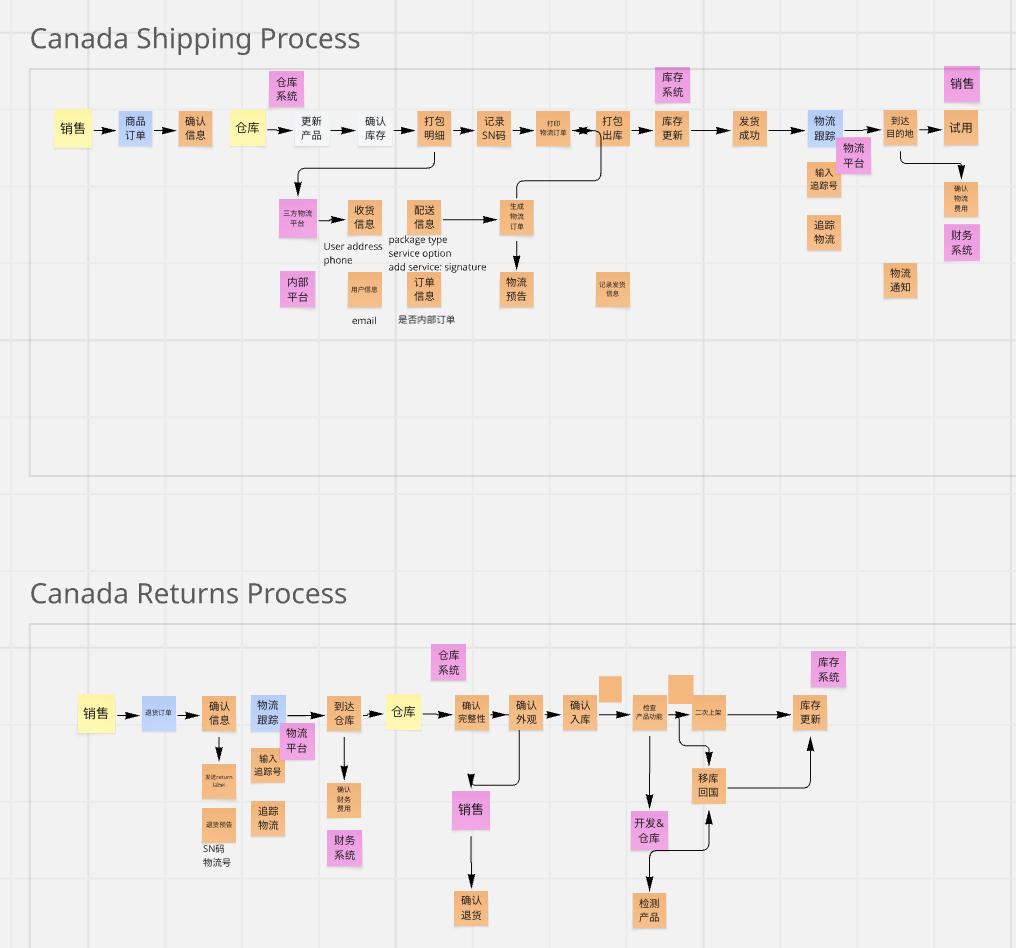
Orka manufactured in Shenzhen but had no way to get products to North American customers. No warehouse, no carrier contracts, no returns process, no customs workflow. The DTC promise meant nothing without a fulfillment pipeline.

I researched, evaluated, and helped stand up the entire logistics stack:

Warehousing: Evaluated 3PL partners and selected ShipBob for US and Canada fulfillment, negotiating storage and pick-pack-ship rates.

Domestic shipping: Set up FedEx integration with order tracking for last-mile delivery.

Cross-border: Managed China-to-North America export via ChuKouYi, including customs documentation, battery compliance (UN38 certification for lithium-ion cells), and import clearance.

Returns: Designed the reverse logistics flow for the 45-day money-back guarantee, a critical trust signal for a $1,800+ purchase from an unknown brand.

07
Breaking the App Before Users Do

The Orka companion app controlled core hearing aid functions: volume, program switching, hearing profiles. Standard QA said it worked. But real users don't follow happy paths. They switch phones mid-call, force-quit during firmware updates, and use the device in ways engineers don't anticipate.

I designed and ran monkey testing scenarios: rapid device switching between iOS and Android, Bluetooth disconnection during firmware updates, app behavior during low-battery states, force-quit during active hearing adjustment, and multiple devices attempting to pair simultaneously. Surfaced 20+ issues that standard QA missed. The most critical: Bluetooth reconnection after interruption was unreliable. For a hearing aid user, that means suddenly losing amplification with no clear recovery path.

08
Cross-team Troubleshooting and Quick Start Guide

As the person who sat between product, engineering, marketing, and supply chain, I became the coordination point for UX issues that didn't belong to any single team. A customer complaint about pairing failure might be a firmware bug, a packaging problem, or a confusing instruction. I helped triage these across teams and fed recurring patterns back into the product.

I also helped refine the Orka Quick Start Guide, the physical booklet shipped with every unit. The original guide assumed technical literacy that most hearing aid users didn't have. I worked to simplify the Bluetooth pairing flow, clarify the audiogram calibration steps, and reduce the number of steps from unboxing to first use.


What stayed with me

Creating a shared language across teams

Engineering talked about latency budgets. Marketing talked about lifestyle positioning. Operations talked about customs codes. The hardest part of working across all three roles wasn't the technical content. It was translating between teams who each had valid concerns but no vocabulary to explain them to each other. I learned that the person who can sit in a room with engineering, marketing, and supply chain and make everyone feel heard is doing product work, even if the title doesn't say it.

Hardware is unforgiving

When I found Bluetooth reconnection bugs through monkey testing, the fix wasn't a quick deploy. It required firmware changes with real manufacturing implications. You can't iterate on a physical device the way you iterate on a screen. Catching issues early is exponentially more valuable when the cost of a fix scales with production volume.

Product experience doesn't end at the screen

Setting up a warehouse and negotiating battery compliance certificates felt like the furthest thing from "product work." But every logistics decision (which 3PL, which carrier, what returns window) had downstream effects on user trust, unit economics, and support load. A $1,800 hearing aid that arrives late, damaged, or with confusing customs paperwork destroys the brand promise before the user even opens the box.

Back to All Projects